“Fear eats the soul.”
Before there was Wong Kar-wai, there was Rainer Werner Fassbinder, crafting stories of longing and unattainable love while transforming production design into a visual language of emotion. Fassbinder’s Ali: Fear Eats the Soul (1974) creates a devastating melodrama about love, racism, age, class, and the social consequences of being perceived as an outsider. Following Emmi Kurowski, an older German cleaning woman, and Ali, a much younger Moroccan migrant worker, Fassbinder constructs an unlikely romance that becomes increasingly threatened by the prejudices of the people surrounding them. Inspired in part by Douglas Sirk’s All That Heaven Allows, Fassbinder transforms the conventional forbidden romance into a story about postwar West Germany and the ways racism, xenophobia, and social conformity determine who is allowed to love openly. Rather than presenting their relationship as inherently tragic because of their differences, Fassbinder makes the society surrounding them the source of their isolation, showing how fear can enter even the most intimate relationships and eventually consume the people experiencing it.
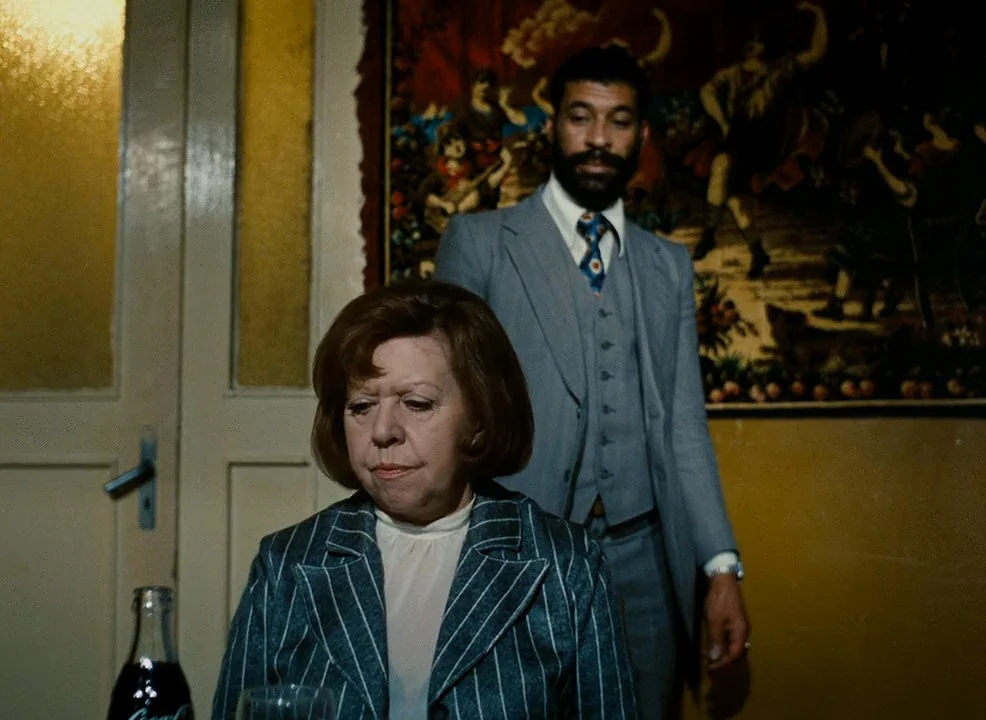
Fassbinder’s direction emphasizes the isolation of Emmi and Ali by repeatedly separating them visually from the people around them. Characters are often positioned at a distance, with Emmi and Ali occupying one space while neighbors, coworkers, or family members occupy another. This staging makes social rejection physical, turning the frame itself into a representation of exclusion. Their relationship initially provides a space where both characters can escape the loneliness imposed upon them by society. Emmi is treated as undesirable because of her age and working-class status, while Ali is treated as foreign and inferior because of his nationality and race. Their attraction therefore becomes more than an unlikely romance; it becomes a temporary refusal of the social categories that have already defined their lives. Yet Fassbinder refuses to romanticize their relationship completely, eventually showing how the pressure surrounding them begins to enter the relationship itself.
Race permeates the narrative, influencing not only how Ali is treated but also how Emmi is treated once she associates herself with him. The racism directed toward Ali is often casual and openly normalized by the people around them, revealing a society that views migrant workers as both outsiders and commodities. Ali is welcomed when his labor is useful but rejected when his presence challenges social expectations. This becomes especially apparent when the people who initially condemn Emmi’s relationship gradually become more accepting once they realize they can benefit from the couple. Fassbinder exposes the conditional nature of this acceptance, demonstrating that prejudice does not necessarily disappear; it can simply become inconvenient when the person being rejected becomes useful. The film therefore connects racism with class and economic exploitation, showing how marginalized people can simultaneously be excluded and valued for what they provide.
Visually, Ali: Fear Eats the Soul maintains the heightened theatricality of melodrama while creating a deliberately uncomfortable distance between the audience and its characters. Fassbinder uses staircases, windows, doorways, and architectural barriers to repeatedly frame Emmi and Ali as people being observed rather than simply people living their lives. The bright colors and exaggerated compositions contrast with the emotional cruelty taking place within the frame, creating a world that feels almost artificial despite the realism of its social conflicts. This visual artificiality is essential to the film because Fassbinder is not interested in allowing racism to disappear into ordinary background behavior. He exaggerates social interactions until their cruelty becomes impossible to ignore. His influence from Douglas Sirk allows melodrama to become a political language, using heightened emotion and visual composition to expose structures of power.
Ali: Fear Eats the Soul also complicates the idea that marginalized people automatically become morally superior because they experience discrimination. Emmi herself eventually participates in the exclusion of another immigrant worker after she regains some of the social acceptance she previously lost. This shift is one of Fassbinder’s most important observations because it demonstrates how oppression can reproduce itself through people who have already experienced it. Once Emmi is welcomed back into her community, she becomes capable of benefiting from the same social hierarchy that previously isolated her. The film therefore refuses a simple division between victims and villains. Instead, it examines how desperately people can desire belonging, even when belonging requires them to participate in the exclusion of someone else.
In conclusion, Ali: Fear Eats the Soul stands as a powerful examination of how racism, class, age, and social conformity can invade the most personal aspects of human life. Fassbinder does not simply tell a story about an interracial relationship; he uses Emmi and Ali to expose the conditions that determine whose relationships are considered legitimate and whose bodies are considered acceptable within society. Their love is genuine, but the film understands that genuine love does not exist outside of social structures. The title becomes increasingly significant as the narrative progresses: fear does not simply prevent people from loving one another—it changes how they see themselves, how they treat others, and what they are willing to sacrifice in order to belong. Fassbinder’s combination of melodrama, social realism, and deliberately artificial visual composition creates a film that is simultaneously intimate and deeply political, revealing how loneliness can bring two people together while society continually attempts to pull them apart.
