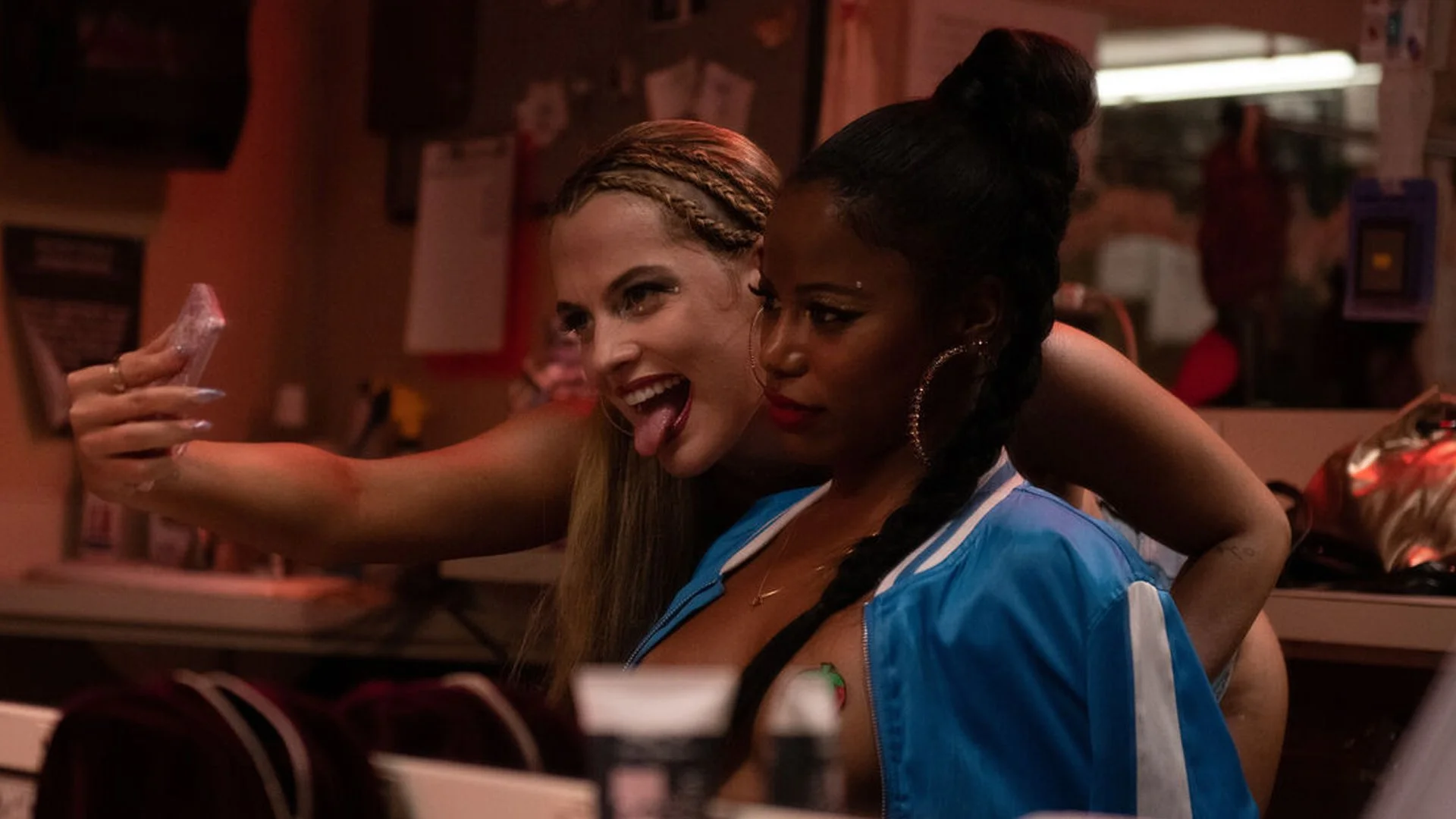
“Y’all wanna hear a story about why me and this bitch here fell out? It’s kinda long, but it’s full of suspense,”
Janicza Bravo’s Zola (2020) adapts from Aziah “Zola” King’s viral 2015 Twitter thread, creating a frenetic yet darkly comedic cinematic experience. From the opening scene, with its fluorescent light, gritty Kodak 16mm aesthetic, and Zola intentional choice of breaking the fourth wall narrative, allows for the film to immerse viewers in a chaotic world of risk, sex work, autonomy and what it means to navigate such a dark world of Southern politics and the sex industry. In under ninety minutes, Zola recounts her travels with a new acquaintance, Stefani, to Tampa, Florida expecting a glamorous out-of-town strip-club adventure. The trip however turns into a surreal encounter, becoming a dangerous odyssey for the pair. Bravo centers Zola’s agency through a complex black perspective of womanhood that shows the audience how poor discretion within interracial friendships concerning loyalty, trust, and true consideration for black bodies can have life threatening consequences, without reducing Zola’s character or black women to stereotypes.
Bravo’s direction with the film emphasizes women's voices. By alternating narration between Zola and Stefani, the film highlights the subjective nature of experience and perception. Stefani’s perspective occasionally clashes with Zola’s, revealing her unconscious biases and underscoring the racial undercurrents of their rather fast-forming relationship navigating a world that offers them little protection. The film deliberately subverts the male gaze by portraying men as grotesque and desperate, while inserting the women’s bodily integrity, creating a space in which female solidarity and survival are foregrounded. Scenes such as Zola helping Stefani raise the price for her sex work underscore the women’s resourcefulness and highlight the moral ambiguities and complexities of their choices.
Race permeates the narrative, influencing the characters’ interactions and shaping the social environment of Tampa. Zola experiences differential treatment from white clients and observes police brutality firsthand, emphasizing systemic inequities. Stefani’s casual appropriation of African American Vernacular English (AAVE), the confederate flags in the background, and the presence of a Nigerian pimp all contribute to a layered exploration of race, power, and trust. Zola captures the constant negotiation Black women must undertake in navigating spaces where they are simultaneously hyper-visible and undervalued. The film’s narrative reflects lived experiences rather than fictionalized entertainment, emphasizing survival and adaptability as central themes.
Visually, Zola maintains an Afro-surrealist sensibility, balancing absurdity and realism through its baroque cinematography, vibrant Florida palette, and kinetic energy. The film’s humor, often dark and chaotic, allows serious themes of exploitation and agency to coexist with moments of levity, providing an authentic rhythm that mirrors the unpredictability of Zola’s world. Compared to contemporaneous films like Anora, Zola presents fully realized female characters with interiority, agency, and resilience. While Anora reduces its protagonist to a dependent, objectified figure, Bravo’s film foregrounds the complexity of Zola and Stefani, highlighting their autonomy even within constrained circumstances.
Zola also contributes to broader conversations about sex work, power, and representation in cinema. The film refuses to romanticize or sanitize its subject matter, instead presenting sex work and exploitation with both levity and gravity. Bravo’s approach underscores the humanity of her characters while critiquing the structures that endanger them. The result is a film that is both entertaining and socially resonant, capable of generating dialogue about agency, race, and survival in contemporary culture.
In conclusion, Zola stands as a testament to the power of female-centered storytelling in capturing lived experience with veracity, humor, and style. Bravo’s adaptation honors the energy, chaos, and intelligence of King’s thread while reframing its themes through cinematic language that balances absurdity and seriousness. The film excels in giving voice to Black women, portraying them as agents of their own narratives rather than objects within male-dominated frameworks. With its distinctive visual style, Afro-surrealist sensibility, and attention to power dynamics, Zola secures its place as a culturally significant and enduring film. It is a story of survival, loyalty, and resourcefulness that resonates far beyond its ninety-minute runtime, offering insight into the complexities of identity, risk, and empowerment in a world that often seeks to diminish both.
“Reason to be a jealous bitch number one!”
Filmnita’s Rating: ★★★★★
