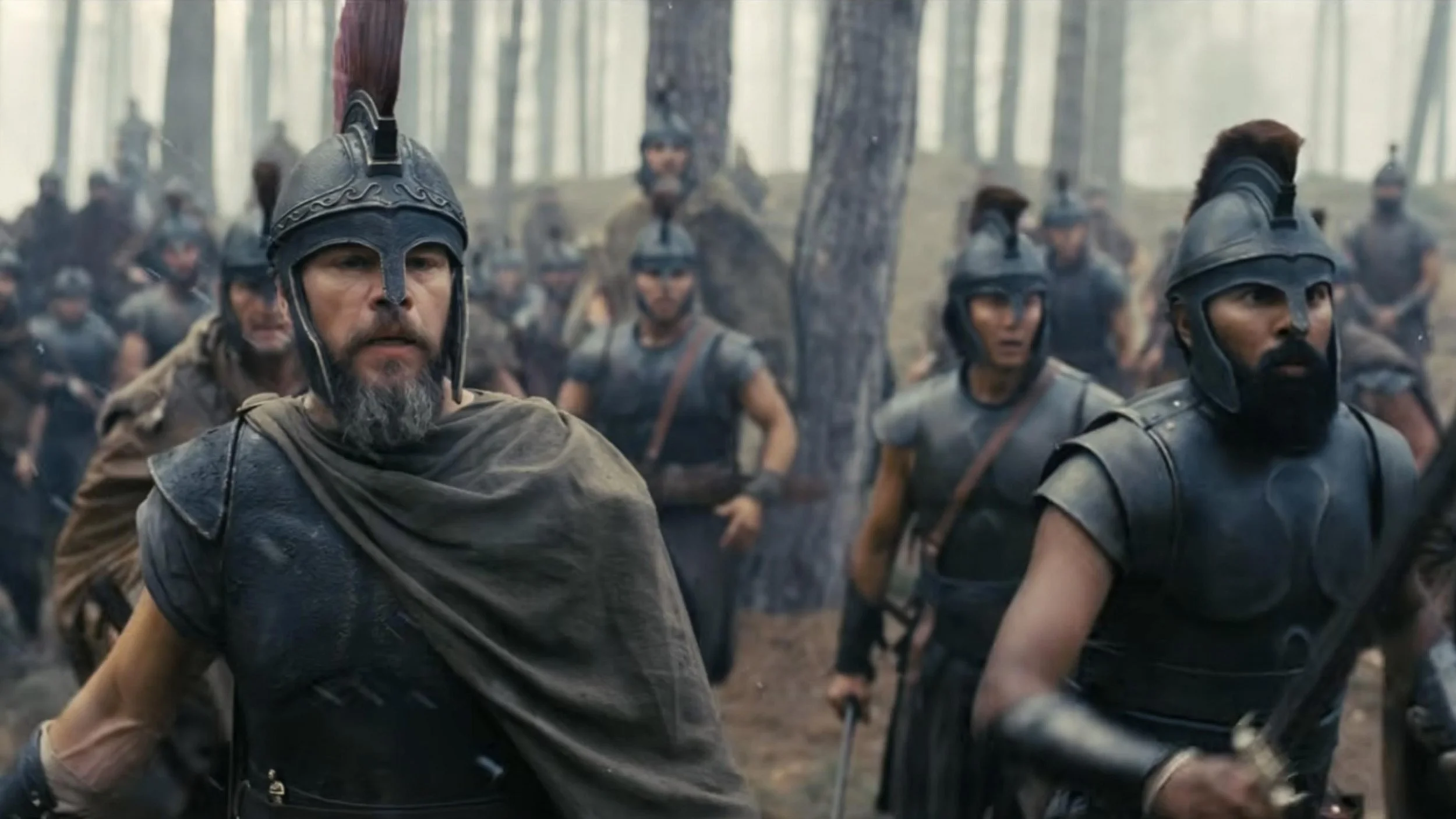
Christopher Nolan’s The Odyssey is a phenomenal cinematic experience, and honestly, I expect nothing less from him at this point. With an extraordinary ensembled cast and an epic that stretches across war, mythology, and the human condition, Nolan delivers a film that feels both intimate and monumental. However, what stayed with me most was not the spectacle of the journey itself, but the emotional consequences of the war that in the end, makes you question, was all this shit worth it? Beneath the monsters, gods, and battles is a story about rage, guilt, and the cost of a man’s ambition (see why patriarchy sucks for everyone!).
One of the film’s greatest strengths is its ability to bring The Iliad and The Odyssey into conversation with one another. While the film centers on the Trojan War and the destructive force of human rage, the latter follows Odysseus as he attempts to return home after the war. These are not entirely separate stories, but two sides of the same tragedy. The violence of the battlefield does not end when the fighting stops. Its consequences follow the men who survive it, shaping their relationships, their identities, and their understanding of themselves. Nolan recognizes this connection and uses it to frame Odysseus’s journey as something more complicated than a heroic adventure. His return home becomes an extension of the war itself, a long and punishing reckoning with the destruction left behind.
I particularly appreciated the film’s attention to the violation of Zeus’s law and the consequences of disrupting the divine order. The Trojan War is not simply a conflict between opposing armies, but a series of human decisions that invite consequences far beyond what any individual can control. The rage of Odysseus, his men, and Agamemnon contributes to a cycle of violence that continues long after Troy falls. What begins as a pursuit of honor, victory, and glory gradually becomes a burden that no amount of triumph can resolve. Odysseus may be celebrated for his cunning wit, and particularly his role in devising the Trojan Horse, but the film invites us to consider what that ingenuity actually cost him. What does it mean to win a war if the journey home leaves you haunted by everything you did to secure that victory?
Matt Damon completely blew me away as Odysseus. I have never considered myself much of a Matt Damon fan, and I realize now that I may have underestimated his abilities as an actor. His performance carries the weight of a man whose reputation precedes him, yet whose internal struggles threaten to consume him. Odysseus is celebrated for his intelligence and resourcefulness, but those qualities exist alongside his pride, anger, and guilt. Damon gives us a man who can command a room and outwit his enemies while still struggling to reconcile the hero the world sees with the person he has become. His performance makes Odysseus’s suffering feel less like the inevitable burden of a legendary figure and more like the consequence of his own choices.
Elliot Page was another standout for me, and I loved his character. Page brings a compelling presence to the film, making a strong impression within an already stacked ensemble. I genuinely hope he campaigns for Best Supporting Actor because I would love to see his performance receive that kind of recognition. Nolan’s casting is one of the film’s greatest assets, and the actors give this mythological world a sense of humanity that keeps it from becoming merely a succession of grand images and legendary encounters.
Visually, Nolan delivers the kind of immersive filmmaking audiences have come to expect from him. Yet spectacle alone would not have been enough to make this adaptation work for me. I have read Robert Fagles’ translation of The Odyssey, which remains my personal point of reference for Homer’s epic, so I was unfamiliar with Emily Wilson’s, the translation that Nolan’s film is based on. Still, I approach literary adaptations with a particular philosophy: a film should be allowed to exist as a film. Literature and cinema are distinct art forms, each with its own language, limitations, and possibilities. I think audiences sometimes become so attached to the source material that they judge an adaptation primarily by what it preserves or changes, rather than considering what the filmmaker is trying to accomplish through the medium of cinema. Fidelity matters, but it should not be the only measure of artistic success.
That does not mean I believe the screenplay is beyond criticism. In fact, I think it could have been written better. I have never considered Nolan a particularly strong screenwriter, even when I admire his films as cinematic experiences. His conceptual ambitions can be extraordinary, but I sometimes find that the writing does not reach the same level as the ideas behind it. The Odyssey is no exception. There are moments when the emotional and thematic possibilities of the story feel more compelling than the screenplay’s execution. Nevertheless, I found the film’s central ideas strong enough to carry me through those shortcomings. My criticism of the writing does not diminish my appreciation for what Nolan achieves as a filmmaker.
What ultimately makes The Odyssey resonate is its understanding that victory and redemption are not necessarily the same thing. Odysseus survives, endures, and becomes the subject of a story that will outlive him. Yet survival does not erase guilt, and glory cannot restore everything that has been lost. His journey becomes a reminder that the consequences of our actions often extend beyond the moment in which we make them. Rage may inspire a man to fight, pride may convince him that he is justified, and ambition may earn him a place in history, but none of these things guarantee peace.
Nonetheless, I left The Odyssey deeply impressed, not simply because Nolan brought one of literature’s most enduring epics to the screen, but because the film reminded me that even the greatest heroes must live with the consequences of their choices. Odysseus may be remembered for the Trojan Horse and his extraordinary cunning, but those achievements cannot be separated from the suffering that followed. Perhaps that is the tragedy of his journey. He wins the war, survives the gods, and fights his way home, only to discover that becoming a legend is not the same as being free. And after everything he has endured, I cannot help but wonder whether the glory was ever worth the cost.
